Insights & Guides
Source review in progress
The Ultimate Guide to Whole-House Water Filtration Systems
By Rainwater Directory Team
Updated January 13, 2025
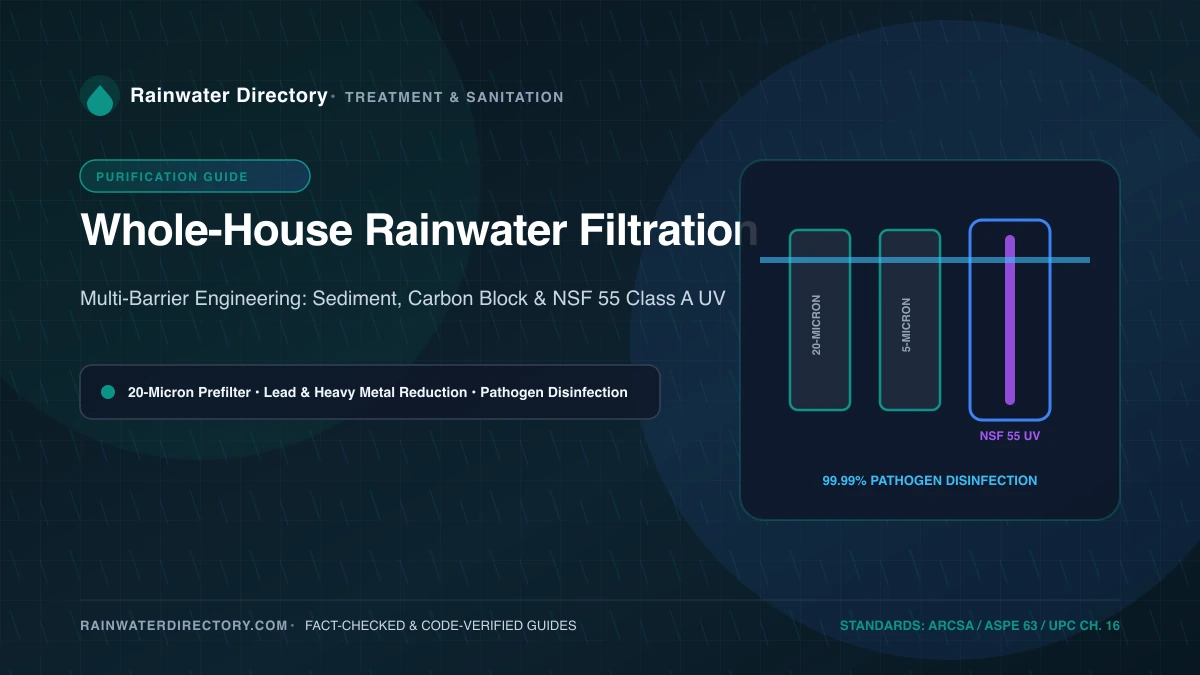
Whole‑house filtration improves taste, protects plumbing, and—when paired with disinfection—can make rainwater suitable for broader uses. Here’s how common technologies fit together.
Core technologies
- Sediment filters: Remove particles (sand, silt, rust). Choose graded stages (50→20→5 µm) or single multi‑depth cartridge.
- Activated carbon (GAC/blocks): Reduce chlorine/chloramine, taste/odors, and many organics.
- Water softeners (ion exchange): Reduce hardness scale; not a filter. Regeneration needs salt and drain.
- Reverse osmosis (RO): Removes dissolved salts/metals; low flow and a waste stream; typically used at a tap, not whole‑house.
- UV disinfection: Inactivates microbes; requires low turbidity and sufficient UV dose.
- Chlorine/chloramine: Provides residual disinfection; common in municipal water and some private systems.
Typical configurations by source
- Municipal tap: Sediment → carbon; softener if hard; optional UV for sensitive use cases.
- Well water: Test first. Often sediment → carbon → softener; add specialty media for iron, sulfur, etc.; UV if microbes present.
- Rainwater (non‑potable whole‑house): Sediment → carbon to protect plumbing, plus labeling.
- Rainwater (potable where allowed): Sediment → carbon → UV or chlorine; maintain log and test periodically. See /blog/can-you-drink-rainwater-cdc-science.
Sizing and maintenance
- Flow rate: Size housings and media for peak gallons per minute (GPM) and desired pressure drop.
- Cartridge life: Track gallons or pressure differential; keep spares on hand.
- UV lamps: Replace annually; clean sleeves; ensure power protection.
Plumbing tips
- Add unions and bypass loops for service.
- Isolate non‑potable loops and label lines clearly.
- Protect from freezing; provide drainage for backwash and softener regeneration.
Related guides
- System components: /blog/complete-rainwater-collection-system-guide
- Tanks by use case: /blog/top-10-water-storage-tanks-100-to-5000-gallons
Disclaimer: Water chemistry and codes vary. Get a water test and consult a licensed installer for design and permitting.