Insights & Guides
Source review in progress
10 Water Storage Tank Types for Homes (100 to 5000+ Gallons)
By Rainwater Directory Team
Updated January 9, 2025
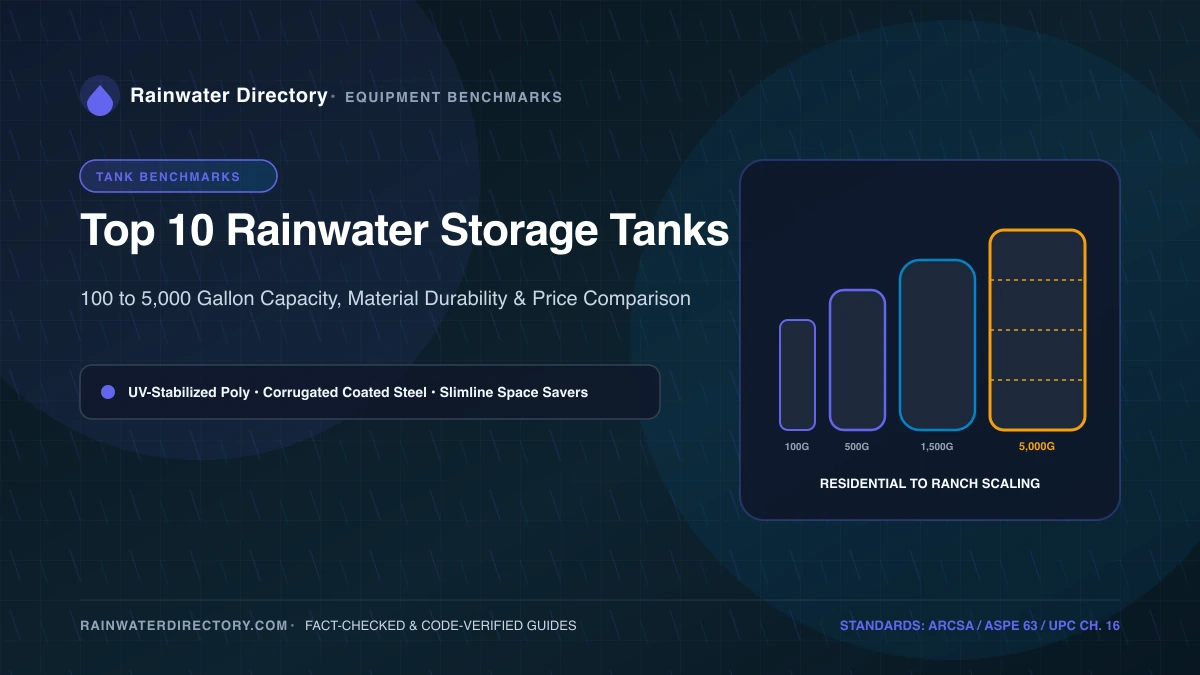
Choosing the right tank depends on required storage, location, budget, and whether the water is potable. These are common tank types rather than product rankings. Start with the rainwater planning calculator to separate annual collection potential from your demand-based storage target.
Quick picks by use case
- Emergency/portable (100–330 gal): Reconditioned IBC tote (food‑grade), small poly barrels.
- Budget irrigation (200–1000 gal): Rotomolded polyethylene (UV‑stabilized) above‑ground tanks.
- Aesthetic/compact: Slimline or decorative polyethylene.
- Large above‑ground (2500–5000+ gal): Corrugated steel with liner; modular and scalable.
- Underground, long life: Concrete or fiberglass cisterns.
- Low‑clearance/indoor crawlspace: Bladder tanks.
Tank types (pros/cons)
- Polyethylene (rotomolded)
- Pros: Affordable, many sizes, simple install; potable models available.
- Cons: UV exposure ages plastic; needs stable pad and sun protection.
- Slimline/decorative poly
- Pros: Fits tight spaces, better curb appeal.
- Cons: Usually higher cost per gallon; limited large sizes.
- Corrugated steel with liner
- Pros: Scales to very large volumes; strong; serviceable liner replacement.
- Cons: Higher upfront cost; requires flat pad; aesthetic/HOA considerations.
- Fiberglass (above or underground)
- Pros: Durable, inert; good for underground installs.
- Cons: Cost; may require professional install.
- Concrete cistern (underground)
- Pros: Long service life; buffers pH; traffic‑rated options.
- Cons: Heavy equipment, excavation, and permitting.
- Bladder tank
- Pros: Fits crawlspaces; low profile; fast to deploy.
- Cons: Requires protective surface; puncture risk; limited very large sizes.
- Reconditioned IBC tote (275–330 gal)
- Pros: Widely available; inexpensive per gallon.
- Cons: Verify food‑grade and prior contents; add opaque cover to block light.
- Galvanized steel (lined vs. unlined)
- Pros: Rugged; farmhouse aesthetic.
- Cons: Unlined tanks not for potable storage; corrosion concerns.
- Modular plastic panels/cells
- Pros: Hidden under decks/landscapes; customizable shapes.
- Cons: Installation complexity; geotextile/liner details matter.
- Wooden tanks with liners
- Pros: Unique look; replaceable liners.
- Cons: Maintenance; not common in all regions.
Buyer’s checklist
- Potable rating and documentation (if drinking).
- Opaque walls, sealed lids, screened vents/overflows.
- Pad/foundation requirements and seismic/wind loads.
- Fittings, unions, and future service access.
- Freeze, sun, and algae mitigation strategies.
Plan your system next
- Components overview: /blog/complete-rainwater-collection-system-guide
- Whole‑house filters and disinfection: /blog/ultimate-guide-whole-house-water-filtration
Disclaimer: Product availability and code requirements vary. Always follow local regulations.